Study-in-China News
A Detailed Comparison between HSK 3.0 and HSK 2.0

Eduprchina
December 3, 2025 Views 25
As the new HSK standards and materials roll out, it’s time to get ahead of the changes-especially if you’re planning to take the exam in the second half of next year. Also, students need to start preparing themselves for a smoother transition. To make things clear for everyone, EDUPRCHINA have put together a detailed visual comparison between the old and new HSK exam.
If you’re learning Chinese or guiding someone who is, this is your go-to resource. Check it out and step confidently into the era of HSK 3.0!
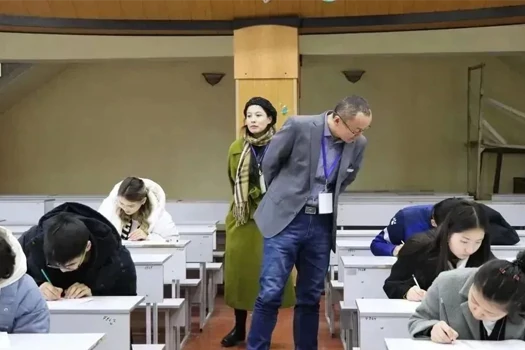
The new HSK represents an evolution, optimization, and systematic upgrade of the current exam, designed to better meet the diverse needs of learners and provide a more scientific and precise assessment of their Chinese communication skills.
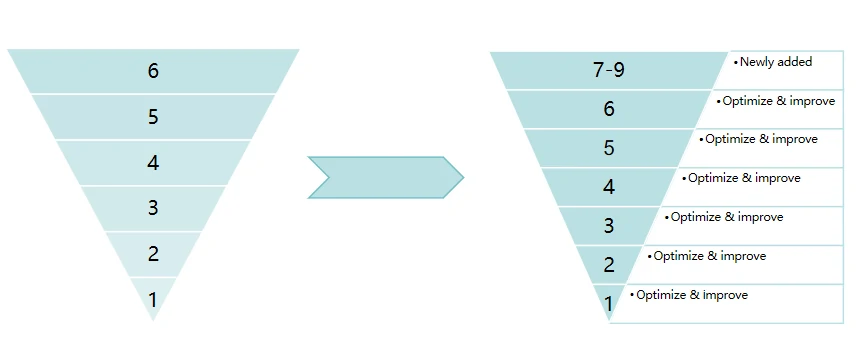
Guided by the "Chinese Proficiency Standards for International Chinese Language Education," the HSK test has upgraded its previous "Level 1 to Level 6" framework to a new "Three-tier Nine-level" system.
Key Differences Between HSK 3.0 and the Current HSK
1. System Restructuring
The former six-level structure has been upgraded to a new Three-tier Nine-level' system, with the addition of HSK Levels 7-9. This establishes a comprehensive Chinese proficiency assessment framework that covers elementary, intemediate, and advanced levels.
2. Competence Orientation
HSK follows the principle of assessing Chinese communicative competence by comprehensively evaluating the five language skils of listening, speaking, reading, writing and translation.
3. Learning for Application
HSK content has been thoroughly optimized to reflect more real-life communicative scenarios, enrich assessment dimensions, expand the range and depth of topics, andprovide a multi-dimensional evaluation of test takers Chinese communicative competence.
4. Enhanced Experience
The question types have been refined, the number of questions and total test duration reduced, and the listening speed adjusted to provide test takers with a brand-new testing experience.
*Translation is assessed exclusively in HSK Levels 7-9.
*Translation is assessed exclusively in HSK Levels 7-9.
Key Adjustments in the HSK 3.0 Level 1-6
The overall structure of question types in the new HSK (Levels 1–6) remains stable, maintaining its focus on assessing practical Chinese communication skills. The updated exam places greater emphasis on enhancing expressive abilities in Chinese, introducing writing assessment from Level 2 and adding speaking assessment from Level 3. Meanwhile, certain question types have been optimized, and the test experience has been refreshed through a reduction in both the total number of questions and overall test duration.
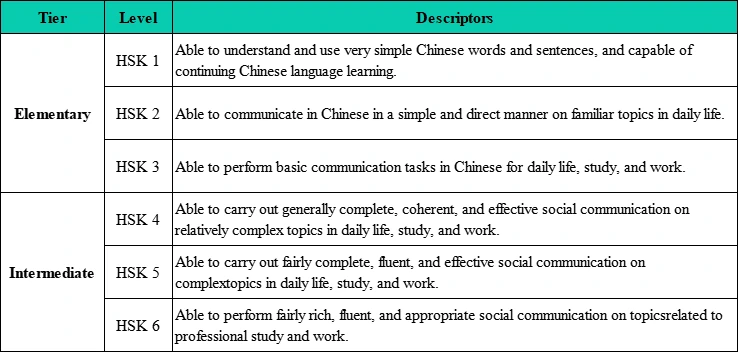
Proficiency Descriptors for the New HSK (Levels 1-6)
Overview of Levels 7-9: Target Candidates
HSK 3.0 (Levels 7-9) is designed for high-level learners of Chinese as a second language. This includes students applying for master's or doctoral programs in China, undergraduate students majoring in Chinese studies worldwide, as well as professionals who use Chinese in academic research, or in economic, cultural, and technological exchanges.
HSK 3.0 (Levels 7-9) adopts a single-test, three-band scoring system. The exam consists of five sections: Listening, Reading, Writing, Translation, and Speaking, with a total duration of 200 minutes.
Sample tests have been released on the Chinese Tests Service website for your reference to better understand the test content and difficulty.
www.chinesetest.cn/HSK/7-9
Resources for the HSK 3.0
1. Official Textbook
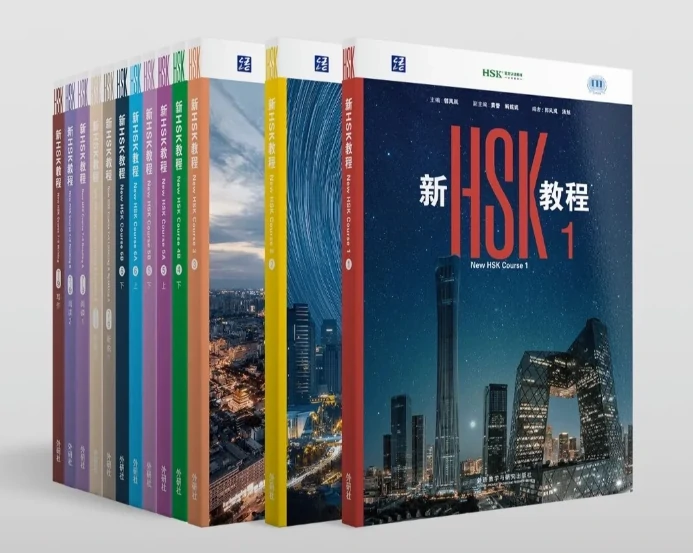
The Chinese Testing International (CTI) is collaborating with the Foreign Language Teaching and Research Press (FLTRP) to develop a brand-new textbook series, the New HSK Course, which is fully aligned with the updated HSK test.
2. Mock Tests
HSK Mock is an officially recognized simulation test platform by Chinese Testing International. Complete sets of practice tests for the new HSK Levels 1 through 9 are now fully available online.
For Mobile Devices: Download the HSK Mock APP
For Computer Access: Visit hskmock.com
3. Syllabus
The new HSK test syllabus covers five components: tasks, topics, vocabulary, grammar, and Chinese characters. It clearly outlines the specific communication objectives that learners are expected to achieve, providing clear guidance for teaching and testing preparation.
www.chinesetest.cn/syllabus
Ensure you're the first to understand the new standards, master the changes, and share these vital insights. For the latest updates and expert guidance, the EDUPRCHINA team is here to help.
Scan QR Code to Contact EDUPRCHINA Consultant
Trending Articles
0 Comments
Popular Articles
2025 EGPC! LIMITED Seats to Talk with 150+ Universities, Sign Up Now!
February 17, 2025

Congratulations on the Successful Holding of the 14th EGPC Conference
May 9, 2025

Global students share cultures with Chinese youth for mutual learning
May 22, 2025

Top Uni in Zhejiang, Hangzhou Normal University Welcomes You!
May 22, 2025
Ancient Chinese martial arts find new home in Benin
June 6, 2025

Fully Funded Bachelor Scholarship in Chongqing!
May 23, 2025

Main Service



Follow Us
Connect with us via social media to keep in touch with our latest news and articles.


